

As the fourth largest food crop in the world, the potato processing industry is experiencing a wave of intelligent upgrading. In this industrial transformation, the peeling process is the core link that affects processing quality, and its technological iteration directly affects the production efficiency and market competitiveness of enterprises. This article will briefly analyze the evolution logic of the three generations of peeling technology in China and provide scientific equipment selection strategies for enterprises.
1、 Development Chart of Peeling Technology
1.0 Mechanical Friction Era (1980-2000)
Represented by the diamond grinding machine, skin removal is achieved through physical friction. The mainstream models include:
-Horizontal skin grinder: generally mixed with sand roller and brush roller, driven by a driving motor to quickly rotate and rub against potatoes to remove the skin. Ideally, the processing capacity can reach 500-1000kg/h.
Technical features: Low equipment investment(20000 to 80000 yuan), the leather is sturdy and durable, but the peeling loss rate is as high as 15%. After peeling, the surface is rough and there are some residues, suitable for small-scale initial processing scenarios.
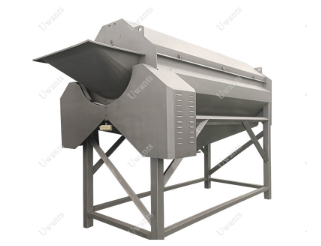
-Vertical cylindrical grinder: With the introduction of large-scale potato chip production lines into China, vertical cylindrical grinders with higher efficiency and greater production capacity are gradually being promoted and applied, and small-sized machines with simple operation have been derived, which are highly popular in the catering industry such as small and medium-sized hotels and canteens. The bottom and cylinder of this leather grinder are coated with diamond sand, which is efficient and fast. Depending on the volume, it can produce tens of kilograms to several tons per hour.
Technical features: The equipment has a relatively small volume, high peeling efficiency, and relatively low equipment investment (ranging from a few thousand yuan to over 100000 yuan). However, the equipment maintenance cycle is short (due to sanding loss), and the peeling loss and rate are not satisfactory. Small equipment is mostly used in small and medium-sized hotels and canteens, while large equipment is mostly used in the potato chip processing industry.
2.0 Precision Cutting Era (2000-2020)
In order to improve the defects such as excessive residue and rough surface of the peeling machine, blade type peeling machines have emerged. The structure of the peeling machine is similar to that of a grinding machine, with high-precision blades embedded at the bottom of the turntable or on the rollers, and the peeling thickness can be adjusted0.5mm, Greatly improve the peeling effect.
Technical features: Reduced peeling loss10% -15%, the production capacity has been increased to 1-2 tons/hour, but the equipment maintenance cycle is short, and the blades need to be regularly polished and replaced. It is mostly suitable for large-scale vegetable processing workshops, central kitchens, etc.
3.0 Thermal Engineering Era (2010 present)
Steam peeling technology opens up a new era of non-contact processing:
-Taolang third-generation steam system: 0.35MPa steam pressure, 3-second skin curing
-Shanghai Yunwang BLAST-VENT technology: 0.5 second rapid pressure releaseput
Technical features: Low peeling loss rate5%, with a production capacity of up to 15 tons/hour; Good peeling effect, smooth surface, almost no residual skin, can be widely used in large-scale potato deep processing enterprises.
2、 In depth analysis of steam peeling technology
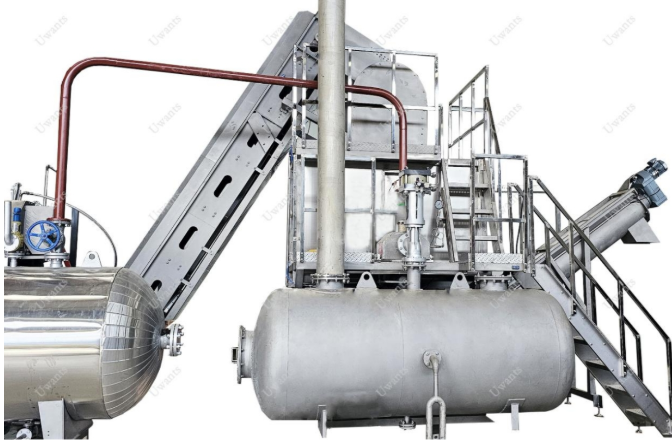
Technical principle: By precisely controlling the vapor phase transition process (liquid state)→ Gaseous→ Liquid state), high-pressure and high-temperature steam infiltrates into the potato skin, forming a micrometer sized water film to separate the skin from the tissue. Then, the steam pressure is instantly released, causing the potato skin to expand rapidly, leading to rupture and detachment. The intelligent pressure control system (IPC) equipped on the Shanghai Yunwang steam peeling machine can achieve± 0.01MPa pressure fluctuation control.
3、 Intelligent selection decision model
Based on research data from multiple food companies, we have developed a multidimensional selection evaluation system:
1. Economic analysis of production capacity
-Small scale (<1 ton/h): Prioritize grinding machines (ROI
-Medium scale (1-2 tons/h): Recommended peeling machine (with the best comprehensive cost)
-Large scale (>2 tons/h): Must choose steam peeling machine
2. Product matrix adaptation
-Potato chip processing: If the production capacity is less than 300kg/h, it is recommended to use a horizontal grinder; Production capacity greater than 300kg/h, vertical grinding machine+optical sorting machine, allowing retention of 5-10% of the skin. To preserve the sweet potato flavor as much as possible, the potato chip processing industry generally does not recommend steam peelers.
-Frozen French fries: with a production capacity of less than 1 ton/h, two horizontal grinders are connected in series; Production capacity>1 ton/h, steam peeling machine. Steam peeled products have a smooth surface and low oil absorption, which can greatly reduce processing costs and significantly improve the quality of French fries.
-Clean vegetable processing: production capacity<1 ton/h, horizontal grinder; Production capacity>1 ton/h, horizontal peeling machine. In the vegetable processing industry, it is generally not recommended to use a steam peeler because the ripening circle generated by steam peeling can affect the appearance and taste of the product.
3. Sustainable development considerations
-Steam equipment can be integrated with a waste heat recovery system (saving 30% energy)
-Grinding and peeling machines need to be equipped with water filtration devices (to achieve 90% water circulation)
4、 Industry Frontier Outlook
withThe penetration of AIoT technology and the fourth generation laser peeling system have entered the experimental stage. The laser array system developed by FoodTech in the United States achieves 0.01mm level skin removal through high-precision spectral analysis and is expected to be commercialized by 2025.
Driven by both consumer upgrading and intelligent manufacturing, the potato processing industry is undergoing profound changes. Enterprises need to establish a dynamic technology evaluation mechanism, which not only considers current production capacity needs, but also reserves space for intelligent upgrading. Choosing an appropriate peeling solution will be the key to determining whether a company can break through the trillion dollar potato industry blue ocean.